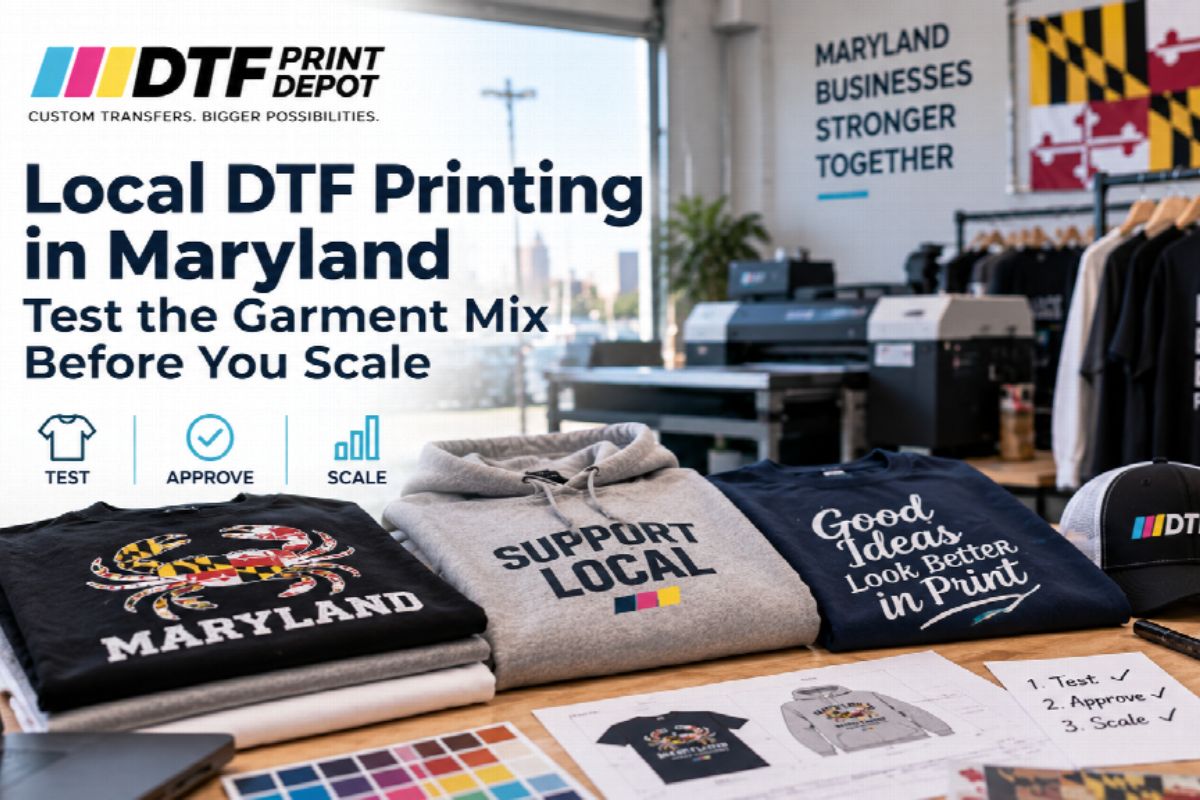
When a business searches for “DTF print near me,” distance is usually one of the first things it considers. But for a Maryland company preparing staff apparel, promotional shirts, merchandise, or event clothing, proximity should not be the only factor.
A better first question is simple: Will the same artwork work the way you expect across the garments you actually plan to use?
A logo that looks right on a standard T-shirt may need different placement or sizing on a hoodie. A design prepared for a lightweight promotional shirt may not create the same visual balance on a heavier garment.
A company ordering apparel for office staff, field employees, events, and merchandise may therefore be dealing with several production decisions inside what appears to be one order. That is why a small garment test can be more useful than immediately placing a large order.
Start With the Real Garments, Not a Hypothetical Sample
Businesses often approve artwork on a screen and then think about apparel afterward. The better sequence is to identify the actual garment categories first.
For example, a Maryland business might need:
- everyday employee T-shirts,
- hoodies for cooler months,
- shirts for customer-facing staff,
- event or promotional apparel,
- merchandise intended for resale.
These products do not necessarily have the same printable area, visual proportions, seams, pockets, or intended use.
Before scaling an order, choose one representative garment from each important category and evaluate the artwork on that garment. This turns the first order into a controlled test instead of a guess.
Check Visual Size, Not Just Transfer Dimensions
A transfer can have technically correct dimensions and still look wrong on the finished garment. The reason is proportion.
An 11-inch-wide design may look balanced on one shirt size but feel oversized on another garment style. A small left-chest logo may work well on a simple crewneck but compete visually with a zipper, pocket, or seam on another product.
When working with a local DTF printing in Maryland option, businesses can make the first sample useful by checking the garment as a finished piece rather than judging only the transfer itself.
Ask:
- Does the logo look centered when the garment is worn?
- Does the design occupy the right amount of visual space?
- Is the artwork still readable from the distance at which customers or employees will normally see it?
Those answers matter more than whether a file simply fits inside a predefined print area.
Separate Core Branding From Variable Apparel
Another useful step is to identify what should remain fixed. For most organizations, the primary logo should not change every time the garment changes. Instead, businesses can establish a consistent core specification while allowing garment-specific adjustments. The logo version may remain the same while the transfer size changes. The brand colors may remain fixed while placement changes.
The overall identity can stay consistent even if one design is prepared for a staff shirt and another for a hoodie. This makes later orders easier because the company is not redesigning its apparel program each time it needs another product.
Use the First Batch to Build a Reference
Once the first garments are approved, document them. Record the garment type, artwork version, transfer dimensions, placement, and intended use. A quick photo of the approved finished piece can also become a useful internal reference.
That record becomes especially valuable when the next order is handled by a different employee. Instead of saying, “Order the shirts we bought last time,” the business can refer to an approved setup. This reduces unnecessary decisions during reorders and helps keep customer-facing apparel visually consistent.
Test Before Mixing Large Quantities
A mixed apparel order creates more variables than a single-product order. Imagine a business needs 40 employee shirts, 15 hoodies, 20 promotional pieces, and a small batch of merchandise.
Treating all of that as one undifferentiated production run can make mistakes expensive. A more controlled approach is to approve representative pieces first and then release the larger quantities after the major variables have been checked.
This does not mean every garment requires a complicated sampling process. The goal is simply to identify the items where a wrong size, placement, or design decision would be costly to repeat.
Why Local Production Can Help the Testing Process
The practical advantage of searching for a DTF print service near Baltimore is not just geography. Local access can support a tighter decision loop between artwork approval, test production, evaluation, and the final order.
DTF Print Depot operates from Arbutus, Maryland, and its website currently lists 24/7 local pickup along with same-day print-and-ship availability for qualifying orders placed before its stated cutoff.
For a business already working against an event date, staff onboarding date, promotion, or customer deadline, reducing unnecessary production uncertainty can be just as valuable as reducing travel distance.
Build a Repeatable Apparel System
The best result of a first DTF order is not simply a stack of finished garments. It is a production reference that makes the next order easier.
Once a business knows which artwork size works on its T-shirts, how a hoodie should be positioned, which logo version is approved, and how different garment categories should be handled, future purchasing becomes much more predictable.
That is particularly valuable for growing businesses that add employees, run recurring events, launch new promotions, or reorder merchandise throughout the year. Local DTF printing should therefore be evaluated as more than a nearby production option.
Used correctly, it can become part of a repeatable apparel workflow: test the real garment, approve the finished result, document the specification, and only then scale the quantities that have already proven to work.